
 For tutors
What happens between sessions decides what sticks
A tutoring session is an hour a week. Here is how to use the other days, with short recall practice spaced out between sessions.
A good session feels like progress. The learner gets it, you both leave happy, and a week later half of it is gone. That isn't a failure of the session. It's how memory works, and it means the days between sessions matter as much as the hour itself.
Tutoring works, when it's built on
One-to-one tuition is one of the better-evidenced ways to help someone catch up. The Education Endowment Foundation's review of the research puts it at around five months of extra progress on average, when tuition is high quality and linked to what the learner is studying (EEF Teaching and Learning Toolkit). That's an average, and results vary a lot. What happens between sessions is one of the things you control.
The week between
Forgetting is steepest in the first day after learning, then it slows (Murre & Dros, 2015). Two things push back:
- Recall, not review. Answering questions from memory makes learning last longer than re-reading notes, even when re-reading feels more productive (Roediger & Karpicke, 2006).
- Spacing. The same practice spread over several days is remembered longer than when it's done in one go (Cepeda et al., 2006).
So the best homework after a session isn't a big worksheet. It's a few short goes at the ideas you just covered, on different days.
A routine that fits a weekly session
- End each session by naming one or two ideas. In plain words: "simplifying fractions before adding", not "fractions".
- Two days later: five questions on those ideas, answered from memory. Ten minutes at most.
- Five days later: three more, mixed with one idea from an earlier week.
- Before the next session, read the answers. Start where they went wrong, not where you planned to.
The last step is the one that changes your sessions. Instead of finding out mid-hour what didn't stick, you walk in knowing.
How Ebiblo fits
Give each learner a private page: one named learner, and only them, so everything on it is for that person and their results stand alone (public, group and private). Learners without an email sign in with a short login code you make for them (adding learners).
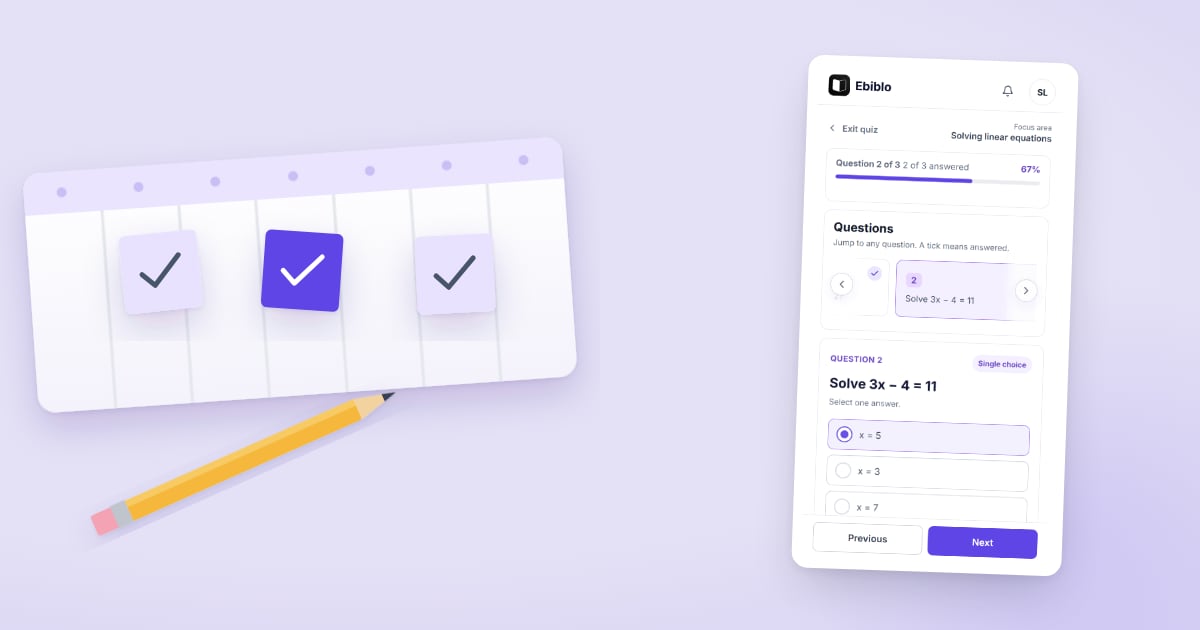
Ask the page's agent for a set on this week's ideas, read it, and publish it when it's right. Choice questions are marked straight away; written answers are marked against the answer you expect, with the reason shown (marking and results). You get a notification when their results come in, so you can read them before you meet.


The free plan covers one quiz page and up to 5 learners, with no card. Starter is one seat with up to 10 learners on private pages (the free plan and paying).
The short version
- The session teaches; the days between decide what stays.
- Two or three short recall sets, spread across the week, beat one long one.
- Read the answers before the next session, and start there.
Sources
- Education Endowment Foundation. One to one tuition. Teaching and Learning Toolkit.
- Murre, J. M. J. & Dros, J. (2015). Replication and analysis of Ebbinghaus' forgetting curve. PLOS ONE, 10(7).
- Roediger, H. L. & Karpicke, J. D. (2006). Test-enhanced learning. Psychological Science, 17(3), 249–255.
- Cepeda, N. J. et al. (2006). Distributed practice in verbal recall tasks. Psychological Bulletin, 132(3), 354–380.